
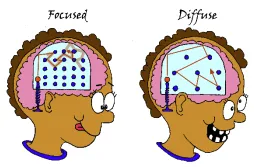
Two modes of thinking:
- focused mode (concentrated, analytical, goal-directed)
- diffuse mode (relaxed, associative, big-picture)
 |
|---|
| Source |
After observing that highly creative individuals like Einstein, Mozart, and da Vinci valued “free-floating periods of thought,” (Andreasen 2011) studied brain activity during idle moments.
Surprisingly, the brain wasn’t idle at all but rather engaged in active processes. This state, called Random Episodic Silent Thinking (R.E.S.T.) or the Default Mode Network (DMN) 預設模式網路 (Raichle et al. 2001), is when the brain actively seeks connections and forms associations, making sense of experiences. The brain continues to work on the problem unconsciously while your conscious mind roams.
DMN is best known for being active when a person is not focused on the outside world, engaged with doing mindless activities (such as walking, running, bike riding, taking shower 1, driving, idle daydreaming, house cleaning, washing the dishes, hanging up the laundry, going to the grocery store, sitting on the beach/couch/sofa, etc.), and the brain is at wakeful rest (such as during daydreaming and mind-wandering 2).
-
Shower Thoughts: Shower is an idea incubator. Keep Aqua Notes ready. ⌃
-
= mindless recharging ⌃
