
Also known as: striders, **accelerations (加速跑)*, or pickups
-
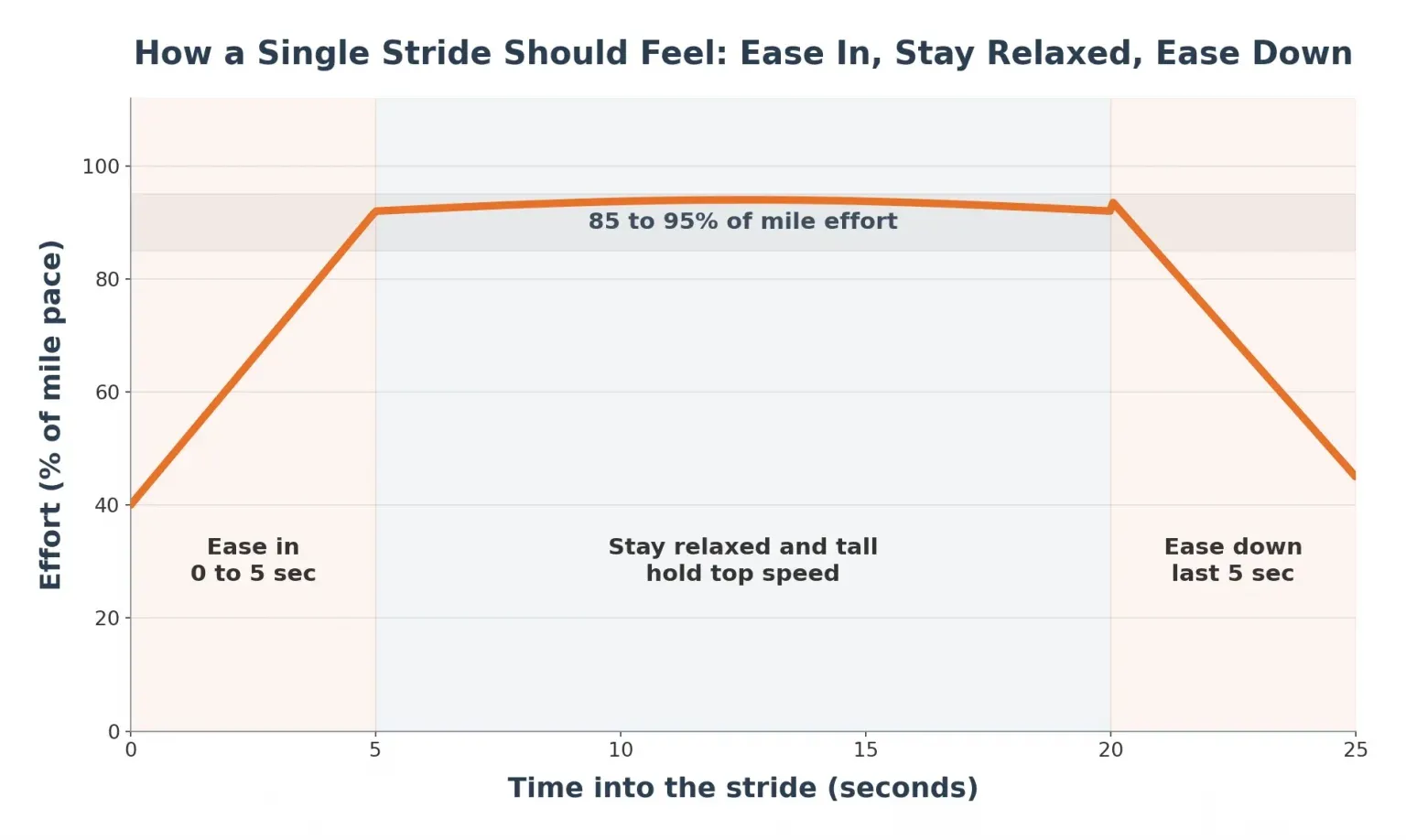
Perform at 85–95% of your running capacity for 20–30 second intervals.
-
Aim to cover 50–100 meters of flat ground with each stride.
-
Accelerate evenly over the stretch of ground, taking care not to reach your maximum effort (it’s not an all-out sprint!), then gradually decelerate until you reach the end of your stride.
-
The goal is to stay fast and relaxed, so you can hold your form the whole way.
-
Take a full recovery between each stride — about 2 minutes.
-
Most runners get everything they need from 4–8 strides, done 2–3 times per week.
-
At the end of an easy run
Strides are completed after your run, not during.
-
Before a race — as a warm-up to activate fast-twitch fibers
- Strides help you work on your mechanics. It’s easy to dial in your form when you’re only running for 20–30 seconds and not yet fatigued. They help you develop mental cues to stay light on your toes and relaxed.
- As distance runners, most training time is spent at slower speeds to build the aerobic system or work on threshold. Strides offer a simple way to inject speed work into your week without dedicating a full workout day. Just a few strides a couple of days a week will put some “get-down speed” back in your legs.
- Strides are an excellent precursor to faster, more rigorous training. They are a gentle introduction for the body and help you get used to the feeling of running at higher speeds.
- Strides serve as a great way to stretch out the legs after an easy session. Legs can grow stale from steady mileage and tempo work. A few strides break up the monotony, refresh your neuromuscular system, and leave your legs feeling less weary.
